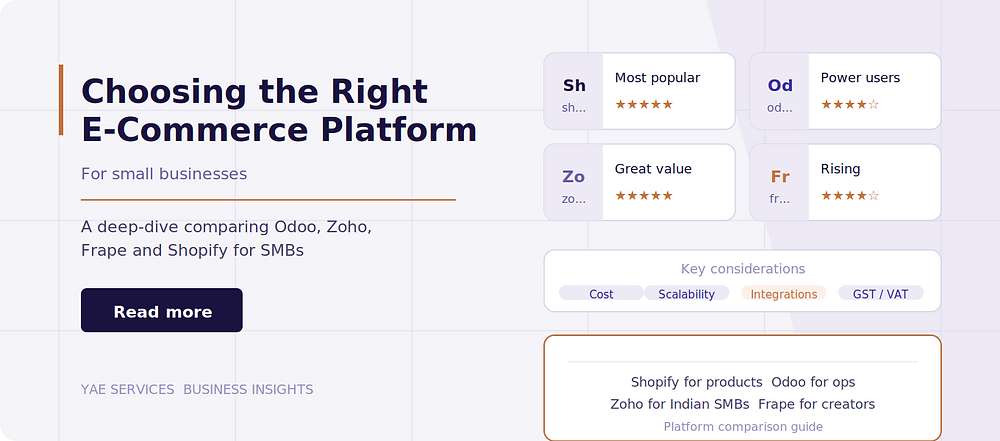
For small business owners, picking an e-commerce platform is one of the most consequential technology decisions you'll make. The wrong choice costs you time, money, and customers. This guide breaks down four leading platforms - Odoo, Zoho Commerce, Frape, and Shopify - across the dimensions that matter most.
KEY CONSIDERATIONS BEFORE YOU CHOOSE
-
Total cost of ownership — Monthly fees, transaction charges, and hidden add-on costs all add up fast.
-
Ecosystem fit — Does it integrate with your existing accounting, CRM, and inventory tools?
-
Scalability — Can the platform grow with you from 10 to 10,000 SKUs without a painful migration?
-
Customisation depth — How much control do you have over storefront design and checkout flow?
-
Technical overhead — Do you need a developer, or can a non-technical founder manage it solo?
-
Localisation & payments — Multi-currency, GST/VAT compliance, and local payment gateway support.
PLATFORM 1: SHOPIFY — The E-Commerce-First Workhorse ★ Most Popular
Shopify is purpose-built for selling online. Its polished storefront themes, enormous app marketplace, and battle-tested checkout make it the go-to for product-first businesses. If your sole focus is commerce and you want to be up and running in hours, Shopify is hard to beat.
Pricing: ₹1,994–₹16,000/month (Basic to Advanced) Transaction fee: 0.5–2% unless using Shopify Payments Best for: D2C brands, product retailers, dropshippers Setup ease: Very easy — no developer needed
Pros:
-
8,000+ apps; huge plugin ecosystem
-
Excellent mobile app and POS integration
-
World-class checkout conversion rates
Cons:
-
Transaction fees without Shopify Payments
-
Limited built-in CRM or ERP features
-
Costs balloon quickly with apps
Ratings (out of 10): Ease of setup: 9.5 | Feature depth: 7.8 | Value for money: 6.8 | Customisation: 7.5
PLATFORM 2: ODOO — All-in-One ERP Meets E-Commerce ★ Power Users
Odoo is an open-source business suite with a fully integrated e-commerce module. If you need your online store to talk directly to your inventory, accounting, HR, and CRM without buying separate subscriptions, Odoo is uniquely compelling — but expect a steeper learning curve.
Pricing: Free (Community) or ~$24/user/month (Enterprise) Transaction fee: None from Odoo; gateway fees apply Best for: Businesses wanting full business operations in one tool Setup ease: Moderate to hard; may need a developer
Pros:
-
Truly unified — store, ERP, CRM, accounting in one place
-
Open source; no vendor lock-in
-
Strong B2B and wholesale capabilities
Cons:
-
Steep setup; hosting overhead if self-hosted
-
Per-user pricing adds up for teams
-
Storefront design less polished than Shopify
Ratings (out of 10): Ease of setup: 4.8 | Feature depth: 9.5 | Value for money: 8.2 | Customisation: 9.0
PLATFORM 3: ZOHO COMMERCE — Budget-Friendly with a Broad Ecosystem ★ Great Value
Zoho Commerce sits inside the broader Zoho ecosystem — meaning seamless integration with Zoho CRM, Books (accounting), Inventory, and Campaigns. For Indian small businesses already on Zoho's suite, this is a very natural extension. Pricing is aggressive and GST compliance is baked in.
Pricing: ₹799–₹2,999/month; free plan available Transaction fee: None from Zoho Best for: Zoho-ecosystem businesses, Indian SMBs Setup ease: Easy to moderate; drag-and-drop builder
Pros:
-
GST-ready with Zoho Books integration
-
Competitive pricing; no per-transaction fees
-
40+ Zoho apps available to connect
Cons:
-
Smaller app marketplace vs Shopify
-
Theme selection limited; less design freedom
-
Support can be slow outside India hours
Ratings (out of 10): Ease of setup: 8.0 | Feature depth: 7.2 | Value for money: 9.0 | Customisation: 6.2
PLATFORM 4: FRAPE — Lean and Creator-Focused Commerce ★ Rising
Frape is a newer entrant targeting lean teams and creator-led businesses. It emphasises speed of launch and social commerce integrations. While it lacks the enterprise depth of Odoo or Shopify's app breadth, it fills a niche for solopreneurs and micro-brands who want a clean, minimal storefront fast.
Pricing: Freemium; paid plans from ~$12/month Transaction fee: Varies by plan; 0% on top tier Best for: Creators, solopreneurs, niche micro-brands Setup ease: Very easy; minimal configuration needed
Pros:
-
Launch in minutes; very low friction
-
Strong social and link-in-bio commerce
-
Affordable entry point for tiny teams
Cons:
-
Limited scalability for complex catalogues
-
Fewer integrations than established rivals
-
Smaller community; fewer tutorials
Ratings (out of 10): Ease of setup: 9.0 | Feature depth: 5.2 | Value for money: 8.5 | Customisation: 5.8
THE BOTTOM LINE
Choose Shopify if your core business is selling physical products online and you want the most mature, reliable platform with the widest third-party support.
Choose Odoo if you're ready to invest in setup time in exchange for a single unified system covering your entire business — store, warehouse, finance, and team.
Choose Zoho Commerce if you're already in the Zoho ecosystem or need GST-compliant commerce without blowing your budget — especially great for Indian SMBs.
Choose Frape if you're a creator or solopreneur who needs a quick, clean storefront for a focused product line with minimal operational complexity.