Introduction: The ERP Decision That Can Make or Break Your Operations
Choosing the wrong ERP in 2026 is not just an IT problem — it is a business risk. The wrong system means wasted implementation budgets, frustrated teams, data silos, and months of painful migration later. The right system, however, becomes the backbone of your entire company: connecting sales, finance, inventory, HR, and operations into one coherent view.
Three platforms dominate this conversation globally in 2026: Odoo, Zoho, and ERPNext (built on the Frappe framework). Each is powerful in its own right, yet each serves a fundamentally different kind of business.
This guide cuts through the marketing noise. By the end, you will know exactly which platform fits your business — and why.
📌 Who Should Read This?
Business owners, operations managers, CTOs, and IT decision-makers are evaluating ERP platforms for the first time or planning to migrate from legacy systems. This guide is especially relevant for SMBs, manufacturers, and fast-growing startups in India and Southeast Asia.
What Is an ERP System and Why Does It Matter in 2026?
ERP stands for Enterprise Resource Planning. At its core, an ERP system is software that integrates all your core business processes into a single platform — accounting, inventory, sales, HR, CRM, manufacturing, and more — so that every department works from the same data in real time.
In 2026, the case for ERP is stronger than ever. Businesses operating on spreadsheets, standalone accounting tools, and disconnected CRMs are losing ground to competitors who have unified their operations. Real-time visibility, automation, and integrated reporting are no longer luxuries — they are baseline expectations for any business serious about scaling.
• Eliminate data silos between departments
• Automate repetitive workflows (invoicing, procurement, payroll)
• Gain real-time financial and operational visibility
• Improve customer experience through faster fulfilment
• Ensure compliance with tax laws, GST, and audit requirements
Platform Overview
Odoo — The Modular Open-Source Powerhouse
Founded in 2005 and headquartered in Belgium, Odoo has grown into one of the world's most widely deployed open-source ERP platforms. It offers two editions: a free Community Edition and a paid Enterprise Edition. The platform is built around a modular architecture — you start with the modules you need and add more as your business grows.
Key strength: Odoo's open-source nature and massive marketplace of over 30,000 apps mean virtually any business process can be automated or customized. Major global enterprises including Toyota, Hyatt, and Danone run on Odoo.
• 30+ official apps covering accounting, CRM, manufacturing, e-commerce, HR, and more
• Access to 30,000+ third-party apps through the Odoo marketplace
• Available both as cloud-hosted SaaS and self-hosted on-premise
• Deep customization possible through Python-based development
Zoho — The SMB-Friendly Cloud Suite
Founded in 1996 in India, Zoho has built one of the most comprehensive cloud-based SaaS ecosystems in the world. While Zoho is best known for its CRM, it has expanded into a full ERP-like suite through Zoho One — a bundle of 45+ integrated applications covering virtually every business function.
Key strength: Zoho is the easiest platform to get up and running. With no servers to manage, no developers required, and a clean user interface, teams can be productive within days. Notable clients include Zomato, Suzuki Motors, and Amazon India.
• 45+ tightly integrated cloud applications in the Zoho ecosystem
• Best-in-class CRM with AI-powered sales intelligence (Zia)
• Fully cloud-based — no infrastructure overhead
• Predictable subscription pricing with strong SMB plans
ERPNext / Frappe — The 100% Free Open-Source Alternative
ERPNext is built on the Frappe framework, a low-code Python/JavaScript web framework, and is maintained by Frappe Technologies based in India. Unlike Odoo, which splits its features between a free Community and a paid Enterprise edition, ERPNext makes its entire feature set available for free under an open-source license.
Key strength: For technically capable teams and cost-conscious businesses, ERPNext delivers full ERP functionality — including double-entry accounting, manufacturing, HR, CRM, and inventory — at zero licensing cost. The Frappe Cloud hosted version is available for teams that prefer not to self-host.
• 100% open-source with no feature gating between free and paid tiers
• Full ERP suite: accounting, inventory, manufacturing, CRM, HR, payroll
• Python/JavaScript stack is approachable for developers
• Strong community in India, particularly for GST compliance
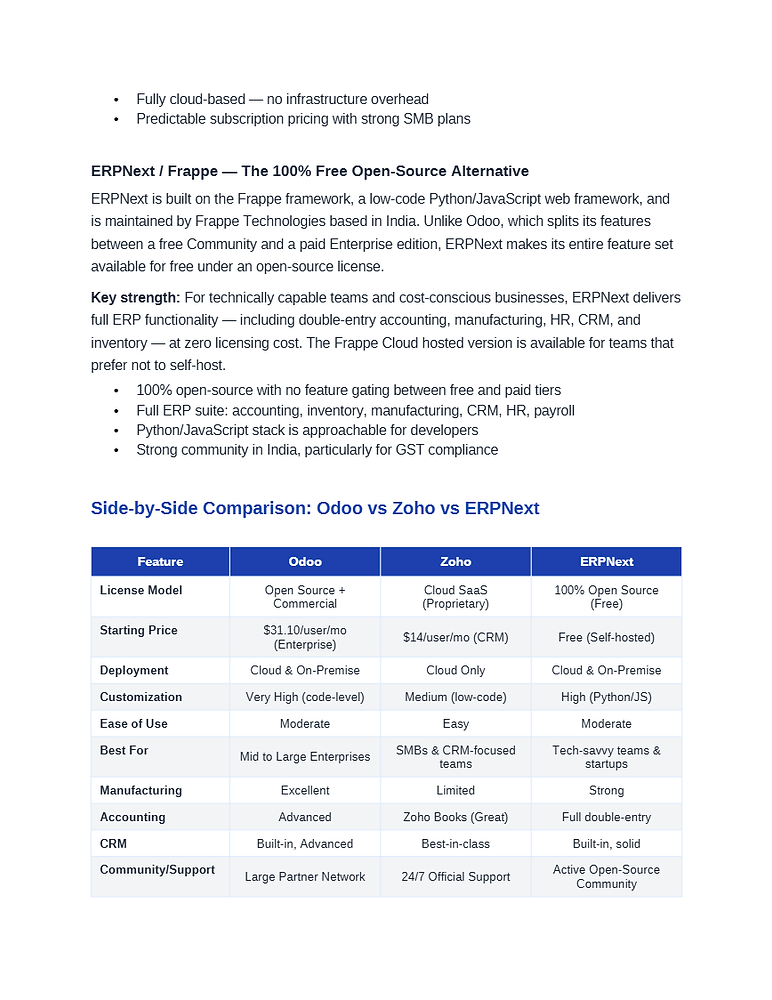
Side-by-Side Comparison: Odoo vs Zoho vs ERPNext
Feature
Odoo
Zoho
ERPNext
License Model
Open Source + Commercial
Cloud SaaS (Proprietary)
100% Open Source (Free)
Starting Price
$31.10/user/mo (Enterprise)
$14/user/mo (CRM)
Free (Self-hosted)
Deployment
Cloud & On-Premise
Cloud Only
Cloud & On-Premise
Customization
Very High (code-level)
Medium (low-code)
High (Python/JS)
Ease of Use
Moderate
Easy
Moderate
Best For
Mid to Large Enterprises
SMBs & CRM-focused teams
Tech-savvy teams & startups
Manufacturing
Excellent
Limited
Strong
Accounting
Advanced
Zoho Books (Great)
Full double-entry
CRM
Built-in, Advanced
Best-in-class
Built-in, solid
Community/Support
Large Partner Network
24/7 Official Support
Active Open-Source Community
App Marketplace
30,000+ apps
45+ integrated apps
100+ modules
Pricing Breakdown: What Will You Actually Pay?
Odoo Pricing
Odoo's pricing model can be confusing at first glance because it has multiple tiers. The Community Edition is free and open-source, but it lacks many advanced features and official support. To unlock the full platform, you need the Enterprise Edition:
• Free: Community Edition (limited features, self-hosted only, no support)
• Standard Plan: ~$31.10/user/month (all apps included)
• Custom Plan: ~$36.80/user/month (additional customization and multi-company support)
Important caveat: While the per-user cost looks reasonable, the real total cost of ownership includes implementation partner fees, custom development, hosting, and module upgrades. For complex deployments, budget 3x to 5x the license cost for implementation.
Zoho Pricing
Zoho offers several tiers depending on whether you want individual apps or the entire suite:
• Zoho CRM Free: Up to 3 users at no cost
• Zoho CRM Standard: ~$14/user/month
• Zoho CRM Professional: ~$23/user/month
• Zoho One (entire 45+ app suite): ~$45/user/month — significantly better value if you use multiple apps
Zoho's biggest advantage is pricing predictability. What you see is what you pay. There are no hidden infrastructure costs, no implementation partner markup for standard deployments, and upgrades are handled automatically.
ERPNext / Frappe Pricing
ERPNext is free to self-host — there is no licensing fee whatsoever. For businesses that prefer a managed cloud experience:
• Self-hosted: $0 (you pay only for servers, roughly $20-50/month on AWS/DigitalOcean)
• Frappe Cloud (managed hosting): Starts at approximately $25/month for small teams
• Implementation partner fees apply if you need professional setup assistance
For Indian startups, manufacturing companies, and NGOs with tight budgets, ERPNext represents an unbeatable value proposition.
💡 Total Cost of Ownership Reality Check
License price is only part of the story. Always factor in: implementation partner fees (often 2-5x license cost for Odoo), training costs, ongoing customization, hosting, and the cost of internal IT time. ERPNext wins on pure licensing cost, Zoho wins on implementation speed, and Odoo wins on long-term scalability for complex businesses.
Feature Deep-Dive: Where Each Platform Wins
Accounting & Finance
Odoo: Advanced multi-currency accounting, bank reconciliation, audit-ready reporting, automated billing, and budgeting. Excellent for companies with complex financial structures or international operations.
Zoho: Zoho Books is one of the most user-friendly accounting tools available, with strong GST compliance (particularly for India), real-time expense tracking, and seamless integration with Zoho CRM. Highly recommended for SMBs.
ERPNext: Full double-entry accounting with support for cost centers, budgeting, multi-currency, and India's GST framework. No features locked behind a paywall.
CRM & Sales
Odoo: Built-in CRM with lead scoring, sales forecasting, marketing automation, and deep integration with inventory and manufacturing. Odoo's CRM app is free even in the Community Edition.
Zoho: Zoho CRM is best-in-class for SMBs and mid-market companies. AI-powered lead scoring (Zia), omnichannel communication (email, SMS, social, phone), and one of the richest out-of-the-box sales automation toolsets available.
ERPNext: Solid CRM functionality covering leads, opportunities, and customer management. Less polished than Zoho CRM but fully functional and completely free.
Manufacturing & Inventory
Odoo: Odoo's manufacturing module is among the best available in any ERP platform. It covers Bill of Materials (BOM), work orders, MRP planning, quality control, and real-time production tracking.
Zoho: Zoho's manufacturing capabilities are limited compared to Odoo and ERPNext. It handles basic inventory and order fulfilment well, but is not suited for complex production environments.
ERPNext: Strong manufacturing support including BOM, work orders, subcontracting, quality inspection, and job cards. Used extensively by Indian manufacturers.
HR & Payroll
Odoo: Comprehensive HR suite including recruitment, employee management, leave tracking, appraisals, and payroll with localization support for multiple countries.
Zoho: Zoho People and Zoho Payroll are excellent standalone products. They integrate deeply with Zoho One, making Zoho a strong choice for companies prioritizing HR automation.
ERPNext: Full HR module with leave management, attendance, payroll processing, and India-specific compliance (PF, ESI, TDS). All free.
Customization & Flexibility
Customization is often the deciding factor for growing businesses. Here is how each platform stacks up:
• Odoo offers the deepest customization capabilities. Businesses can modify modules, create custom workflows, build entirely new apps, and extend the platform at the code level using Python. This power comes with a cost — customization requires developer expertise and increases implementation complexity.
• Zoho provides customization through its drag-and-drop interface and the Zoho Creator low-code platform. Non-technical users can build custom forms, workflows, and dashboards. However, very complex or industry-specific customizations may hit limitations.
• ERPNext supports deep customization through its Frappe framework. Developers familiar with Python and JavaScript will find it accessible. Importantly, customizations survive version upgrades better than Odoo thanks to the framework's patch-based approach.
Shopify vs Odoo Comparison: Choosing the Right Fit
Who Should Choose Which Platform?
Your Situation
Our Recommendation
You need deep customization & manufacturing
✅ Choose Odoo
You're an SMB focused on CRM & sales
✅ Choose Zoho
You want 100% free & open-source ERP
✅ Choose ERPNext (Frappe)
You have no dedicated IT team
✅ Choose Zoho
You want to scale globally with modularity
✅ Choose Odoo
You need full ERP without licensing fees
✅ Choose ERPNext
Special Consideration: ERP for Indian Businesses in 2026
For businesses operating in India, all three platforms offer GST compliance and local tax support — but with nuances:
• ERPNext was built in India and has the most comprehensive native GST support, e-invoicing (IRN/QR code), e-way bill generation, and GSTR filing integration. It is the default choice for many Indian SMBs and manufacturers.
• Zoho Books is the gold standard for accounting and GST compliance in India for small businesses. Its GSTN-integrated filing, TDS tracking, and India-specific payroll make it exceptional for service businesses and SMBs.
• Odoo has improved its India localization significantly, with GST, TCS/TDS support, and e-invoicing available. However, it often requires an implementation partner familiar with Indian compliance to configure correctly.
🇮🇳 Our Pick for Indian SMBs
For most Indian small and medium businesses: start with Zoho One if you are primarily service-based or CRM-driven. Choose ERPNext if you are in manufacturing or trading and want a zero-license-cost solution with strong India compliance. Go with Odoo if you need deep customization and have the budget and IT resources to support a complex implementation.
Thinking About Migration? Key Questions to Ask First
If you are already using one of these platforms and considering switching, or if you are migrating from legacy software like Tally, QuickBooks, or an older ERP, here are the critical questions to answer before you commit:
• What are your non-negotiable features? List the five features your business absolutely cannot function without.
• What is your real budget? Include implementation, training, customization, and ongoing support — not just the license fee.
• Do you have internal IT resources? Odoo and ERPNext require technical expertise. Zoho does not.
• How complex are your workflows? Simple, linear workflows suit Zoho. Multi-department, multi-location, or manufacturing workflows suit Odoo or ERPNext.
• What is your growth plan? If you expect to triple in size in three years, Odoo's scalability may justify the higher upfront investment.
Final Verdict: Odoo vs Zoho vs ERPNext in 2026
There is no universally 'best' ERP — only the best ERP for your specific business. Here is how to think about it simply:
Choose Odoo if you are a mid-sized to large business with complex operations, manufacturing needs, or a requirement for deep customization and you have the technical resources to support it.
Choose Zoho if you are an SMB or a CRM-heavy business that wants to be up and running quickly without a development team. Zoho One is particularly compelling for service businesses, agencies, and companies where sales pipeline management is the core priority.
Choose ERPNext if you want a fully open-source ERP with no licensing costs, strong India compliance, and a developer-friendly framework. It is the honest open-source alternative that Odoo once was before it commercialized its advanced features.
Whichever platform you choose, invest time in a proper needs assessment before signing up. Request demos, run pilot projects with real data, and talk to businesses similar to yours that are already using the platform.
The right ERP will not just organize your business — it will transform how you work.